
The Top Benefits of Edge Computing Architecture
The way we interact with technology is constantly evolving. From bulky desktop computers to smartphones that fit in our pockets, the trend is clear: processing power is moving closer to the user. This is where edge computing architecture comes in. A world where your devices can analyze and react to information instantly, without having to send data back and forth to a faraway data center. That's the promise of edge computing architecture. It's a new way of distributing computing power!


Most requests do not need a faraway data center to make every decision. In an edge computing architecture, code runs nearer the user or device when a short response matters, while the cloud still handles work that benefits from central scale. The gain depends on placement, caching, and operations. Moving code outward does not automatically make it faster or safer.
Key Takeaways
- Place latency-sensitive work near the user or device; keep central analytics and durable storage in the cloud.
- Compare the full request path, not just edge execution time. Origin fetches and device networks can erase the expected gain.
- Treat distributed security and configuration as an operational cost, not an automatic benefit.
- Mobile edge computing helps where radio-network proximity matters, but deployment location and carrier integration still determine results.
- Pair compute with CDN routing and observability so each user reaches a healthy edge.
What is Edge Computing Architecture?
Edge computing architecture is a distributed computing framework that brings enterprise applications closer to data sources such as local edge servers.
This proximity to data sources allows for quicker response times and reduced bandwidth usage, fundamentally shifting the dynamics of how information is processed and delivered.
The architecture is designed to be versatile, supporting various platforms and frameworks that help in integrating old and new infrastructure seamlessly.
{{promo}}
Benefits of Edge Computing Architecture
Edge computing architecture offers a range of advantages that enhance performance, security, and efficiency across numerous industries.
Let's go deeper into how edge computing empowers various applications.
1. Reduced Latency
Traditional computing sends data to a central server for processing, then sends the results back. This can be slow, especially for tasks that need a quick response.
Edge computing solves this by processing data on edge platforms closer to where it's collected, like local servers near smart factory machines. This cuts down on travel time for the data, resulting in faster processing and quicker results.
Think of it like this: with regular internet, you ask a question in another city and wait for the answer. With edge computing, it's like having someone answer right next to you , much faster! This is especially useful for applications that need real-time results, like mobile gaming or traffic control systems.
2. Improved Bandwidth Management
Normally, all the data collected from devices has to travel to a central location for processing. This can clog up the network like a crowded highway, slowing things down for everyone.
Edge computing helps by processing some data locally, on edge platforms near the data sources. This reduces the amount of data traveling on the network, keeping it clear and efficient. There’s a busy office with lots of people sending emails. If everyone sent giant attachments, the email system would get overloaded.
With edge computing, some processing could happen on each computer before sending the email, like resizing attachments. This way, less data travels on the network, keeping things running smoothly for everyone.
3. Enhanced Security Measures
Edge computing offers security benefits by keeping sensitive data processing local. This means less data travels across networks, reducing the chance of it being intercepted by attackers during transit.
It also adds another layer of security with Edge Web Application Firewalls (WAFs). These firewalls act like security guards specifically positioned at the network's edge, where data enters and leaves.
They can identify and block malicious attacks before they reach critical systems or data storage. So, even if some unwanted traffic gets through, the WAFs act as a strong secondary defense.
{{promo}}
4. Easy and Affordable Growth
Unlike traditional computing that relies on one central server, edge computing lets you add processing power as your needs grow. You can simply add more edge platforms, like local servers or gateways, instead of constantly upgrading a central server. This is much more cost-effective, especially for businesses that are constantly expanding.
Edge computing also offers greater flexibility for developers. With edge serverless computing, they can deploy applications directly on the edge platforms without having to worry about managing the underlying servers themselves. This saves time and effort, allowing developers to focus on creating innovative applications.
5. Reliable Operations Even with Issues
Regular computing relies on a central server. If that server fails, everything connected to it stops working. Edge computing distributes processing tasks among many units. Even if one device malfunctions, the others can keep handling their tasks.
This is especially valuable for situations where downtime is very expensive. For instance, in a factory, if a central server fails, production might halt.
With edge computing, individual machines can keep operating even if one device has an issue. This helps maintain reliability and minimize disruptions in critical environments.
6. Less Energy Use, Lower Bills
Normally, data travels long distances to be processed in big data centers. This constant data flow requires a lot of energy. Edge computing keeps data processing closer to where it's collected, so it doesn't have to travel as far. This translates to less energy used overall.
Similarly, large data centers have powerful computers that use a lot of electricity. Edge computing often uses smaller units at the network's edge, which require less power to run.
This reduction in power consumption adds up, especially when you consider the vast number of edge platforms that can be deployed.
7. Support for IoT Integration
The Internet of Things (IoT) connects numerous devices that constantly generate data. However, sending all this data to the cloud for processing can be slow and inefficient. This is where edge computing shines.
Edge computing allows some processing to happen directly on gateways near the IoT sensors. This local processing enables faster analysis of the data.
For example, an industrial machine might use edge computing platforms to analyze sensor data and detect potential equipment issues before they cause a breakdown. In this case, the Edge computing architecture diagram can be pretty simple, which is not always the case.
Because of processing data locally, edge computing empowers IoT devices to react quicker, make smarter decisions, and ultimately improve the overall efficiency and functionality of the entire IoT network.
8. Optimized CDN Performance
We all know how frustrating slow loading times can be, especially when watching videos or downloading files. Edge computing helps CDNs, which deliver content on the internet, work better.
By generating content on servers closer to users, edge computing reduces the distance data needs to travel. This means websites and services load faster, videos stream smoother, and large files download quicker because the work happens closer to users!
9. Regulatory Compliance & Data Sovereignty
Edge computing architecture helps organizations comply with privacy regulations by allowing sensitive data to be processed locally, rather than transferring it to distant data centers or across borders.
This local handling reduces the risk of non-compliance with laws like GDPR, HIPAA, or regional data governance standards, while also improving control over data residency.
10. Supports Mobile Edge Computing and 5G Readiness
Mobile edge computing architecture plays a vital role in enabling ultra-low latency services over 5G networks.
By placing compute resources closer to mobile users, often at base stations or access points, this setup supports real-time applications like augmented reality, remote surgery, and smart logistics.
It allows high-speed, location-aware services without relying on distant cloud servers.
11. Enables AI and Machine Learning at the Edge
Edge computing allows AI and machine learning models to run locally, without sending data to the cloud. This means decisions can be made in milliseconds, which matters for use cases like facial recognition, predictive maintenance, robotics, or autonomous systems.
Processing data at the edge also ensures privacy and reduces the bandwidth needed to train or apply models.
Edge vs. Cloud: A Comparison
{{promo}}
Applications of Edge Computing Architecture
Edge computing network architecture is revolutionizing various sectors by enabling more efficient, responsive, and context-aware applications. Here are some of the areas where it is making a significant impact:
1. Autonomous Vehicles
In the automotive industry, edge computing plays a crucial role in processing the vast amounts of data generated by sensors in autonomous vehicles.
Through processing this data locally, edge computing allows for real-time decision-making regarding vehicle navigation and safety protocols, minimizing the response time needed to avoid accidents.
2. Smart Cities
Edge computing facilitates the smart management of urban infrastructure such as traffic lights, public transport, and energy systems.
Because of processing data on-site, edge computing can help optimize traffic flow, reduce energy consumption, and improve public safety by enabling faster responses to changing conditions.
3. Healthcare
Edge computing software architecture is transforming healthcare by enabling real-time monitoring and analysis of patient data.
This technology is vital in remote patient monitoring systems where immediate medical data analysis on edge platforms can alert healthcare providers to potential health issues before they become critical.
4. Industrial Automation
In manufacturing, edge computing helps to monitor and control industrial processes in real time. It processes data on edge platforms directly from manufacturing equipment to quickly identify and address potential issues, increasing efficiency and reducing downtime.
{{promo}}
5. Retail
Retailers use edge computing to enhance customer experiences through personalized recommendations and targeted advertising, driven by real-time data analytics.
This is especially effective in physical stores equipped with IoT devices that interact directly with customers.
6. Energy Management
Edge computing is crucial for optimizing energy usage in smart grids and renewable energy systems. It processes data from sensors to dynamically adjust power generation, distribution, and consumption, which helps in maximizing efficiency and sustainability.
7. Video Analytics
Edge computing is used extensively in security and monitoring through real-time video analytics. Since it is processing video data locally, it enables immediate actions like identifying and alerting about unusual activities without significant delays.
8. Gaming
In gaming, the edge computing architecture minimizes latency and enhances the overall player experience by hosting game servers on edge platforms closer to players.
This results in faster reaction times and a more consistent connection during online multiplayer games.
How Edge Computing Architecture Works With a Multi-CDN Strategy
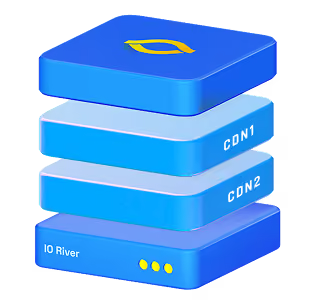
A CDN places cached content near users. Edge compute runs code near a request. A multi-CDN strategy chooses which provider receives that request; the function decides what to do once it arrives. These are complementary layers. Routing cannot rescue a function deployed only on the failed provider, and running code on every edge does not choose the healthiest path.
Start by separating portable logic from provider-specific features. Authentication checks, redirects, and lightweight personalization may be candidates for serverless edge computing. Shared state, large database joins, and long-running jobs often belong in a central service unless you have a clear distribution plan. Keep the user-facing response consistent even when the execution location changes.
- Deploy equivalent routes and security rules on each participating CDN. Test headers, cookies, cache keys, and error responses before shifting traffic.
- Keep state in a service that every edge can reach, or design explicitly for regional state. Do not assume functions on different providers share memory.
- Use traffic steering to send users to a healthy provider, then use monitoring across providers to confirm that the function and cache behave as expected.
- Track execution time, origin calls, and end-to-end user latency separately. A fast function can still lead to a slow page if it waits on a distant database.
Run a failover drill with the function enabled, not just a static file. The backup path must have the right code version, secrets, and permissions. If one provider cannot support a feature, define the fallback behavior before an incident, so routing does not trade an outage for a broken response.
For example, if an edge function adds a user-specific header before a cache lookup, that header might change the cache key on one CDN but not another. You could get slower pages or cache content under the wrong rule. Write down the request and response contract for each function, then test it through every provider with the same fixtures. Watch cold starts, regional availability, and provider limits too; they may differ even when code runs on both platforms. Your goal is not identical dashboards. It is the same safe user outcome, with enough telemetry to see which layer caused a failure.
Conclusion
To sum it all up, Edge computing is ushering in a new age of processing power that resides at the network’s edge. This distributed approach translates to faster results, lower costs, and a more connected future for businesses and users alike.This distributed approach empowers businesses to innovate across industries and build a more responsive and connected future.
FAQs
1. How Does Edge Computing Reduce Network Bandwidth Costs?
Edge computing architecture processes data locally instead of sending large volumes to a distant data center or cloud. Filtering or summarizing data locally can reduce backhaul traffic and its cost. By handling tasks at the network’s edge, businesses can reduce congestion, save on transfer costs, and speed up applications.
2. What Is the Difference Between Cloud Computing and Edge Computing?
Cloud computing relies on regional data centers for most processing, while edge computing network architecture runs selected workloads nearer users or devices. This proximity reduces latency, enhances real-time decision-making, and lowers bandwidth needs. Essentially, cloud focuses on large-scale centralization, whereas edge prioritizes local responsiveness and resilience.
3. What Industries Benefit Most From Edge Computing?
Industries with strict latency or local-processing needs may benefit most. Manufacturing uses it for predictive maintenance; healthcare for rapid patient data analysis; retail for local inventory tracking; and media/gaming for ultra-low latency. Results still depend on placement, connectivity, and the application.
4. Is Edge Computing More Secure Than Cloud Computing?
Edge computing offers enhanced security in many ways. Local processing can reduce unnecessary data transfers, but it does not remove the need for encryption. It also allows organizations to implement custom, location-specific security protocols and increases the number of systems you must secure. However, it requires robust edge device management to maintain consistent protection across all nodes.
5. How Does Edge Computing Work with Cloud Infrastructure?
Edge computing doesn’t replace the cloud; it complements it. Edge handles time-sensitive work locally, while cloud services handle long-term storage, large-scale analytics, and central management. This hybrid approach leverages the strengths of both models, providing speed at the edge and scale in the cloud.